
Fort Bend County · Cosmetic or structural
Foundation Crack Repair in Sugar Land, TX
Before any patching, find out whether a crack is just in the finish or a sign the house has moved.
- Free inspection
- No obligation
- Town-by-town soil data
- You never pay us
- Call (832) 539-7922

Foundation crack repair in Sugar Land starts with one question: is the crack only in the finish, or is it telling you the foundation moved? A crack in the finish can be patched once it has stopped. When movement made the crack, fix what moved first. Otherwise the new patch simply cracks along the old line.
Most cracks fall in the first group. Per the ASCE Texas Section's foundation guidelines, most cracks leave concrete's structural integrity intact. The trick is telling which kind you have, and a few minutes with a pencil and a calendar goes a long way.
Tell us what you're seeing
Cosmetic or Structural? Where Foundation Crack Repair Begins
Four kinds of crack are worth telling apart:
- Hairline cracks in drywall, plaster or the top of a slab. HUD's guide for inspecting older homes says wall and ceiling cracks often come from small seasonal movements with heat and humidity, and that some open and close on a regular cycle.
- Stair-step cracks in brick, following the mortar joints. HUD's guide says cracking from settlement usually runs on a rough diagonal along the mortar, near corners and openings.
- Diagonal cracks running from the corner of a door or window. They're one of the signs on the ASCE Texas list, along with racked door frames.
- Slab cracks across the concrete floor or the exposed edge of the slab.
Three details push a crack toward "structural":
- Size. HUD's housing inspection standard flags a foundation crack a quarter inch or wider and a foot or longer.
- Taper. HUD's guide says a crack that's wide at one end and tapers to a hairline at the other often points to faster settlement.
- Freshness. Clean, crisp edges suggest recent movement. A dirty or previously filled crack may have stopped.
Four common crack patterns
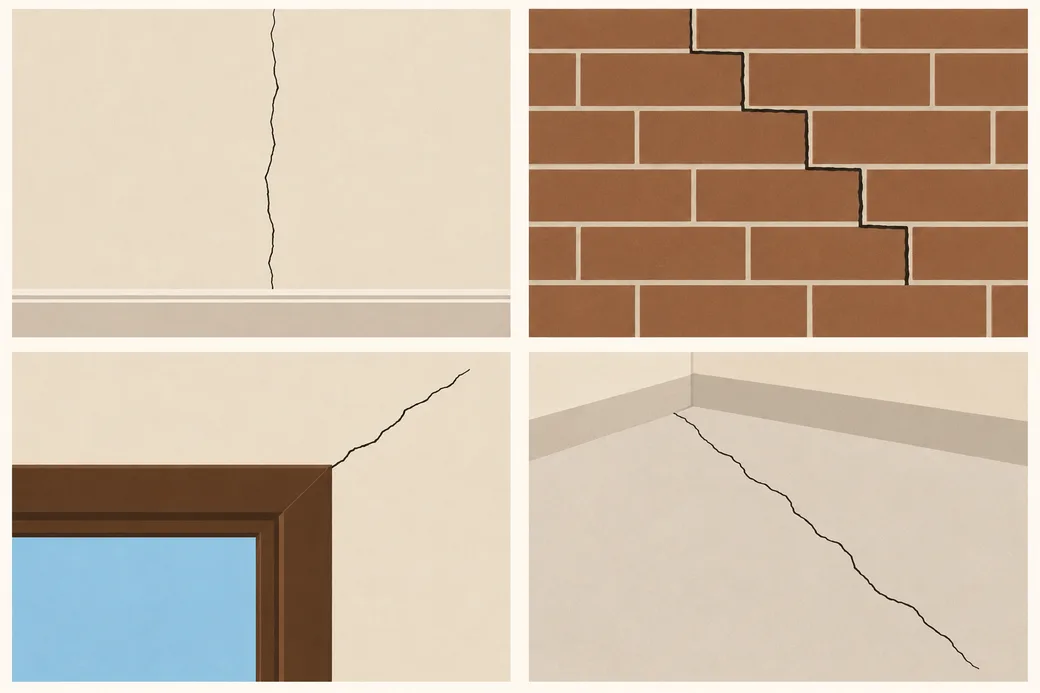
- A thin crack running down a painted wall
- A stair-step crack following the brick joints
- A crack climbing away from the top corner of a window frame
- A long, wandering crack across a concrete floor
River Clay, Prairie Clay or Sand: What Changes
Cracks in a house often follow cracks in the ground. Around Sugar Land, the ground does crack. The USDA describes Lake Charles clay, the main prairie soil, opening cracks up to 2 inches wide in a dry spell and staying open 60 to 90 days in most years. It says Pledger clay, on the river bottom, cracks 20 to 50 inches deep when dry.
So on river or prairie clay, a crack in the house that widens through a hot summer and narrows after fall rain usually tracks the soil. At NOAA's Sugar Land station, July averages 3.76 inches of rain, less than June's 5.67 or August's 4.95. July and August highs average about 94°F.
On the Katy terrace, the sandy soil moves less. If a crack there keeps growing, a leak or water pooling against the house deserves a look first. Find your own lot's soil with the steps in our soil guide.
After a Flood or a Drought
New cracks after a flood are worth measuring, but not right away. FEMA explains that floodwater and soaked soil push up on a slab, and moving water can wash soil from under it. Let the yard dry, then check whether the cracks are still changing.
After a long drought, cracks often widen. Sugar Land's drought plan lets you hand-water the soil beside a foundation at any time, in every stage. Watering evenly won't close a crack overnight, but it can keep the soil from drying further on one side.
How the Work Is Done
A careful crack repair goes in this order:
- Mark it. Draw a line across each end of the crack and date it. HUD's guide says crack monitors sold for the job can measure movement, and that seasonal movement may take six months or more to show.
- Measure the floors. A floor survey shows whether the crack sits over a part of the house that has dropped or risen.
- Fix the cause. That may mean piers under a section of slab, better drainage, or a plumbing repair, depending on what the readings show.
- Repair the finish. Once the movement has stopped, the crack in the wall or floor is patched.
Before anyone drills a slab crack
Many slabs built since 1980 carry steel cables under heavy tension inside the concrete. Builders often stamp a notice into the garage floor to say so. If it's there, the cables must be located before anyone drills into the slab, even to fill a crack.
Cost and What Drives It
The cost depends on the cause more than the crack. A finish crack is a small patch job. A crack caused by movement means paying for the fix underneath. For a slab, a Houston company's rate card lists $370 for an outside pier and $425 for an inside one, before digging and other lines. Houston-area engineers list $350 to $700 for an inspection with floor readings.
A free inspection from a repair company is the cheapest way to find out which kind you have. Our cost guide covers the full range.
Foundation Crack Repair Questions
My house is only a few years old. Should it already have cracks?
It can, and that doesn't always mean trouble. The ASCE guidelines say foundations aren't built dead level to begin with. HUD's guide adds that a half-inch crack in a new building may mean rapid settlement, so a wide crack in a young house is worth measuring.
Is it fine to caulk or patch a crack on my own?
For a hairline crack that isn't changing, yes. But mark and date it first, and wait a season. Filling it early hides the evidence of whether it's still moving.
Should a cracked garage floor worry me?
Not always. If one side of the crack sits higher than the other, or it keeps widening, have it looked at. Check for a post-tension stamp before drilling.
Towns We Serve
We serve Sugar Land and nearby towns: Stafford, Missouri City, Mission Bend, Fresno, Rosenberg, Pearland, Pecan Grove, Richmond, Sienna, Cinco Ranch, Fulshear and Katy.
Related Services
- Foundation inspection To measure before anything is patched
- Slab foundation repair When a crack points to slab movement
- House leveling When cracks come with sloping floors
Get a Free Crack Inspection in Sugar Land
Send us a note about the crack and where you live. A local foundation repair company will check it, measure the floors and tell you which kind it is. It's free, and you decide what comes next.
Tell us what you're seeing