
Short answer: the goal is soil that stays about equally moist on every side of the house, not soil that's soaked. Water lightly, a foot or two out from the slab, and only when the ground is dry. What you're allowed to use in a drought depends on who sends your water bill. Sugar Land and Richmond let you hand-water a foundation at any time in every stage. Katy and Fulshear allow soaker hoses with limits. Many plans don't mention foundations at all, and their strictest stages ban outdoor watering outright.
What our data shows
- Of the area drought plans we read, four write in a rule for foundations: Sugar Land, Richmond, Katy and Fulshear.
- Only Katy and Fulshear name soaker hoses as allowed.
- At NOAA's Sugar Land station, July averages 3.76 inches of rain, less than June's 5.67 or August's 4.95.
- The USDA says Lake Charles clay, common on the prairie, stays cracked for 60 to 90 days in most years.
Why Watering Matters on Fort Bend Clay
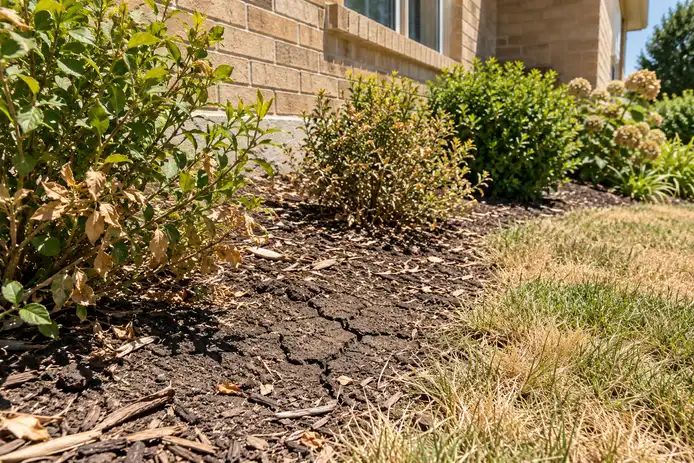
Most of the ground around Sugar Land is clay that grows when wet and shrinks when dry. Brazoria clay, on the Brazos River bottom, reads 17 on the USDA's shrink-swell scale. Lake Charles clay, on the prairie, reads 13.6 and cracks up to 2 inches wide in a dry spell.
When one side of a house dries out faster than the other, that side of the slab can drop. The Foundation Performance Association, a Houston-area group of engineers and repair firms, sums up the fix in four words: "Uniformity is the key." The ASCE Texas guidelines agree that keeping the moisture near even on all sides "may be beneficial." They add a caution against watering too much.
On the Katy terrace, around Katy and Cinco Ranch, the soil is sandier on top and moves less. Even moisture still helps there, but leaks and drainage usually matter more.
When to Water
There's no set schedule that fits every house, and no source we trust gives one. Watch the ground instead. The Foundation Performance Association advises watering only in dry periods, when the lawn and plants start to wilt.
The weather gives you a rough calendar. At all 11 NOAA stations we checked around Sugar Land, July gets less rain than both June and August. July and August are also the hottest months, with average highs near 94°F at the Sugar Land station. That stretch is when clay dries fastest. Winter is the driest season by rainfall, but the heat is gone, so the soil loses less to the sun.
How to Water
The Houston engineers' maintenance guide is specific about method:
- Water a foot or two out. Apply water at least 1 to 2 feet from the slab, and lightly, so tree roots aren't drawn toward the house.
- Don't fill the gap. If the soil cracks and pulls away from the slab in a long dry spell, don't pour water straight into the gap.
- Keep sprinklers off the house. Spray shouldn't hit the walls.
- Cover the ground. Use mulch or another ground cover reaching at least 5 feet out from the foundation.
- Don't trap water. Avoid metal edging or anything that dams water within 5 feet of the slab.
- Move roof water away. Downspouts should carry water at least 5 to 10 feet from the house.
The ASCE Texas guidelines add a slope rule: the ground should fall at least 6 inches over the first 10 feet out from the house.
Soaker hoses and drip lines
The same group weighs the tools. Soaker hoses put water down more slowly than sprinklers and are the easiest to install.
But they can cause uneven, excessive moisture, wear out early, and draw roots toward the foundation if laid around it. Burying them cuts evaporation. For drip systems, it recommends a moisture meter. Because water can be rationed in a drought, it also suggests a soil moisture sensor with automatic controls.
Trees and Shrubs
A mature shade tree can draw the moisture out of the clay under a corner of the house. The Houston maintenance guide suggests keeping broadleaf trees, such as oak, ash or pecan, no closer to the foundation than the tree's height. It recommends pruning every 2 to 3 years to hold the canopy in check.
Removing a big tree has its own risk. The ASCE Texas guidelines warn that the soil can swell back once the tree is gone, especially if the tree is older than the house. Trimming the canopy is often gentler than cutting the tree down. The guidelines point homeowners to an experienced arborist for that call.
Who Sets Your Watering Rules
This is the part people miss. Your rules come from whoever supplies your water, and that's often not your city. Fort Bend County says it doesn't provide water at all and sends residents to their water bill. Katy says its rules cover City of Katy customers only. Many homes around Sugar Land are served by a municipal utility district, or MUD, with its own plan.
So the first step is simple: look at your water bill and find the supplier's name. The rules below belong to that supplier, not to the town on your mailing address. Regional water authorities and the Fort Bend Subsidence District set no household watering days.
The Plans That Name Foundations
Sugar Land. The city's 2022 plan lets you water "the soils directly abutting the foundation" at any time, in every stage including the last. You can use a hand-held hose with a shut-off nozzle, a bucket or can of 5 gallons or less, or drip irrigation. The plan describes drip as "typically installed below ground," so don't assume a soaker hose on the surface counts.
Richmond. Its 2019 plan uses the same any-time rule, in every stage, with the same three methods. Sprinkler days go by neighborhood zone, not house number.
Katy. For City of Katy customers, the 2024 ordinance lets you water a foundation for up to two hours on any day in Stages 2, 3 and 4, by handheld hose or soaker hose.
Fulshear. The 2024 plan defines foundation watering as the soil within 2 feet of the slab. In Stage 1, an attended hand-held hose is allowed at all times.
In Fulshear's Stage 2, foundations may be watered only on your designated day, outside 9 a.m. to 7 p.m. Allowed tools then are an attended hand-held hose, or a soaker hose or drip line laid inside 24 inches of the slab with no spray above ground. The plan doesn't say whether Stage 3 allows it.
Plans That Don't Mention Foundations
In these plans, a foundation is treated like any other part of the yard, and the strictest stages ban outdoor watering:
- Missouri City (2025): hand watering on your designated days in Stages 2 and 3; Stage 4 bans lawn and garden watering.
- Rosenberg: hand watering any time in Stage 2, on your days and hours in Stages 3 and 4, and not at all in Stage 5.
- Manvel: hand watering any time in Stages 1 and 2, on your days and hours in Stages 3 and 4, and banned in Stage 5. This covers city water customers only.
- Iowa Colony: the city's posted 2024 plan allows hand watering any time in Stage 2 and bans lawn and garden watering from Stage 4.
- Pecan Grove MUD (2013): no hand-held exception; all outdoor use is limited to two days in Stage II and banned in Stage III.
- Fort Bend County MUD 81, Weston Lakes (2019): no hand-held exception; outdoor use is limited to two days a week from the first stage, with 6 to 10 a.m. and 6 to 10 p.m. banned, and stopped entirely in the severe stage.
- Cinco MUDs 7 and 12: a voluntary mild stage starts every June 1, so a summer notice is routine. Hand watering is allowed any time in the moderate stage, then limited, then banned in an emergency.
- North Mission Glen MUD (2024): hand-held hose only in the moderate stage; all outdoor use banned in the severe stage.
If your supplier follows a plan like these, the time to keep the soil even is early in a drought, on your allowed days, before the top stage arrives.
No Plan Online
We couldn't find posted drought rules for Stafford, Meadows Place, Arcola, Needville, the utility districts around Fresno and Cumings, or the Sienna utility districts. Pearland's current full plan wasn't online either. In 2023 the city asked residents not to let foundation watering run into the street. If you live in one of these places, call the supplier on your bill.
Questions About Foundation Watering
How much water does my foundation need?
There's no reliable number for every house, and we won't make one up. Water when the ground is dry and the plants start to wilt, water lightly, and keep the soil looking about the same all the way around. An inexpensive soil moisture meter gives you something firmer than a guess.
Can I run a soaker hose in Sugar Land during a drought stage?
The city's plan names hand-held hoses, buckets and drip irrigation, and it describes drip as typically installed below ground. A soaker hose laid on top of the ground isn't named. Ask the city before relying on one in a strict stage.
The soil has pulled away from my slab. Should I fill that gap with water?
No. The Houston engineers' guide says not to pour water directly into that gap. Water a foot or two out instead, and let it soak in slowly.
Is watering a cure for a foundation that's already moving?
No. Even watering helps keep clay from shrinking further, but it doesn't reverse movement that has happened. If cracks keep growing, have the floors measured.
For the soil itself, see our soil guide. Each town page names its own supplier's rule, and you can go back to the Sugar Land homepage.
Sources
- City of Sugar Land, 2022 Retail and Wholesale Drought Contingency Plan.
- Richmond Code of Ordinances, chapter 34, Retail Drought Contingency Plan (2019).
- Katy Ordinance No. 3138 (2024); Fulshear's 2024 Drought Contingency Plan.
- Missouri City's 2025 Drought Contingency Plan; Rosenberg and Manvel drought codes; Iowa Colony's posted 2024 plan.
- Drought plans of Pecan Grove MUD, Fort Bend County MUD 81, Cinco MUDs 5, 7 and 12, and North Mission Glen MUD.
- Pearland's 2023 Stage 1 release; Fort Bend County's water service notice.
- Foundation Performance Association papers FPA-SC-07-0 and FPA-SC-01-0.
- ASCE Texas Section residential foundation guidelines, version 3, section 7.3.
- NOAA 1991-2020 normals for Sugar Land-area stations.
- USDA official soil series description for Lake Charles; National Soil Survey Handbook shrink-swell classes.