
Fort Bend County · Raised floors
Pier and Beam Foundation Repair in Sugar Land, TX
Raised floors are rare in Sugar Land and more common in Richmond, Rosenberg and Katy. Here's what goes wrong under them and how it's put right.
- Free inspection
- No obligation
- Town-by-town soil data
- You never pay us
- Call (832) 539-7922

Pier and beam foundation repair in Sugar Land means fixing a house that stands on short supports over a crawl space, rather than on a slab. The usual work is resetting, shimming or adding supports so the beams carry the floor evenly again. A free inspection starts with a look underneath.
Most Sugar Land homes went up after 1990, and only 2.6% before 1960, the Census says. So a raised floor is the exception in Sugar Land. Next door, it's more common. Richmond built 13.0% of its homes before 1960, Rosenberg 9.8% and Katy 5.3%.
Tell us what you're seeing
When You Need Pier and Beam Foundation Repair
A raised floor gives different clues from a slab. Here's what tends to show up:
- A floor that feels soft or bouncy in one room
- A slope you can feel walking from one wall to the other
- Doors that swing open or shut on their own
- Gaps opening between the baseboard and the floor
- Cracks in drywall above doors and windows
The ASCE Texas Section's guidelines list framing that tilts or sags, and joints that were once tight and have opened, among the signs engineers check. They're also clear that a sign or two doesn't prove the foundation has failed. The crawl space usually holds the answer. A wet crawl space, rotted wood, or a support that has sunk or leaned all point to the cause.
Where Pier and Beam Homes Are Around Sugar Land
The Census records when each home was built, not what it stands on. Across Texas, though, raised floors were far more common in houses from the 1940s and 1950s than in newer ones. Industry sources describe many older Texas homes standing on stacks of concrete blocks set on small pads at the ground surface.
That's where the older homes cluster near Sugar Land:
- Richmond: 13.0% of homes from before 1960, with a median build year of 1979
- Rosenberg: 9.8% before 1960
- Katy: 5.3% before 1960
- Sugar Land: 2.6% before 1960
Needville, farther south, has the most of any town we studied: 34.1% of its homes predate 1960.
River Clay, Prairie Clay or Sand: What Changes
A block-and-pad support sits right on top of the soil. So whatever the soil does, the support does too.
River bottom. Richmond's older core sits near the Brazos, where Brazoria clay reads 17 and Pledger clay 19 on the USDA's shrink-swell scale. Supports on that clay rise and fall with the seasons. One fix is adding supports that reach deeper, below the soil that moves.
Coastal prairie. Rosenberg's older homes sit mostly on prairie soils. Lake Charles clay reads 13.6, and Edna, at 6.6, holds water on its clay layer for 2 to 4 weeks after a long, heavy rain. A crawl space over that ground can stay damp through a wet spell.
Katy terrace. Katy's soil is sandy on top, with clay loam reading 3.8 from about 29 inches down. Supports there move less, so look at water first. A leak or poor drainage can soften the ground under just one post.
To check your own lot, follow the steps in our soil guide.
After a Flood or a Drought
A raised house handles floodwater differently from a slab. FEMA's homeowner guide explains that when water can flow in, the pressure inside and outside evens out, and walls are much less likely to fail. After a flood, though, the crawl space needs to dry out, and any wood that sat wet should be checked.
Raising a home above flood level is easier with a wood floor than with a slab, FEMA says. If you're weighing that, Sugar Land's floodplain page says the space left under a raised house may need flood vents and water-resistant materials. Our flood zones guide explains how house raising works.
In a drought, clay under the supports shrinks. Sugar Land's drought plan lets you hand-water the soil next to a foundation at any time.
How the Work Is Done
Pier and beam repairs tend to fall into a few kinds of work:
- Re-shimming. Wood shims can compress over time, and some companies swap them for steel ones. Shims raise a sagging spot, but they don't fix why it sank.
- Resetting or replacing supports. A tilted or sunken block stack is rebuilt on a firmer base.
- Adding supports. New piers go in where the beams span too far or the old supports have failed.
- Replacing damaged wood. Rotted sills, beams or joists get replaced.
If the house is jacked, the ASCE Texas guidelines call for leak tests on the water and drain lines afterward. They also call for floor readings after the work, with a copy for you.
What holds up a raised floor
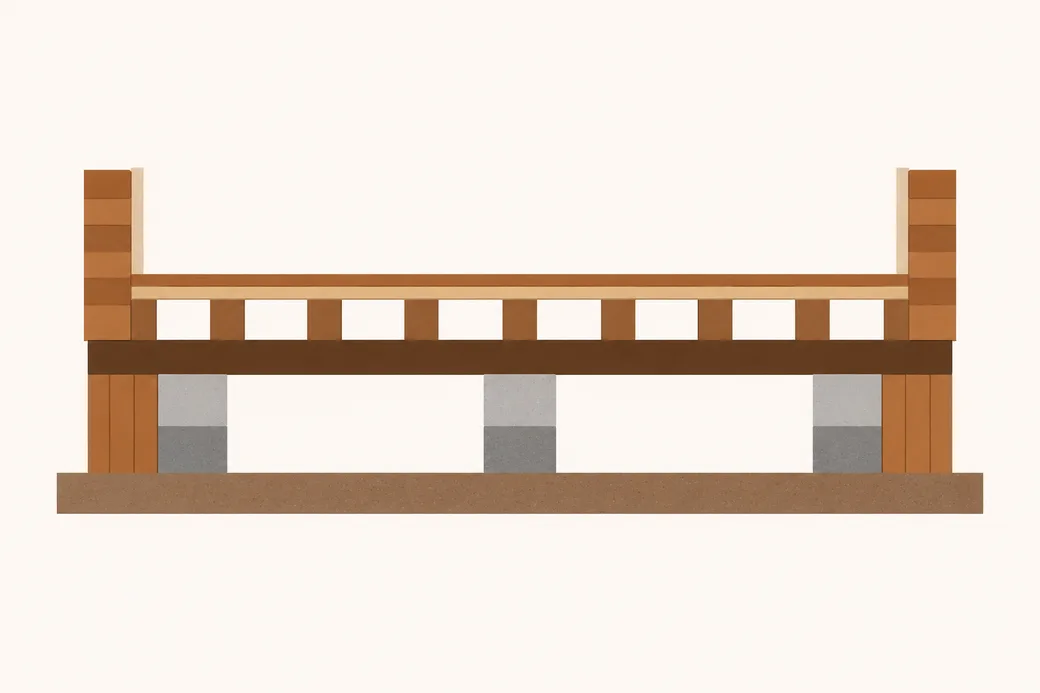
- Concrete-block piers standing on level ground
- A timber beam resting on top of the piers
- Floor joists across the beam, with the subfloor and floor above
- The open crawl space under the floor
Cost and What Drives It
One large Texas repair company reports an average of about $10,763 to repair and level pier and beam homes in the Houston area, from jobs booked in 2026. A Houston company's cost guide lists $800 to $6,500 for releveling alone. Those are different jobs, not a disagreement. One may include new supports and new wood, the other only shims.
What drives your price is how many supports need work, what condition the wood is in and how easy the crawl space is to reach. Our cost guide compares the Houston sources.
Pier and Beam Foundation Repair Questions
What gives away a pier and beam house from the street?
Walk around the outside. Vents or a small access door near the base of the walls usually mean a crawl space. A slab house sits with its floor almost at ground level.
Will new shims fix a sagging floor for good?
Only if the cause is fixed too. Shims lift the floor back, but if the support under them keeps sinking, or wet wood keeps softening, the sag returns.
Is raising a house for flooding the same as foundation repair?
No. House raising lifts the whole home above flood level, and it's a separate trade. FEMA advises never to try it without experienced design and building professionals.
Towns We Serve
We serve Sugar Land and the towns around it, including the older housing in Richmond, Rosenberg and Katy, plus Stafford, Missouri City, Mission Bend, Fresno, Pearland, Pecan Grove, Sienna, Cinco Ranch and Fulshear.
Related Services
- House leveling To bring floors back toward level
- Foundation inspection For a look under the floor and a set of readings
- Slab foundation repair If your house turns out to be on a slab
Get a Free Pier and Beam Inspection
Tell us how your floors feel and where you live. A foundation repair company that serves the Sugar Land area will check the crawl space and the floor levels, then explain what they found. The visit is free, and there's nothing to sign.
Tell us what you're seeing